


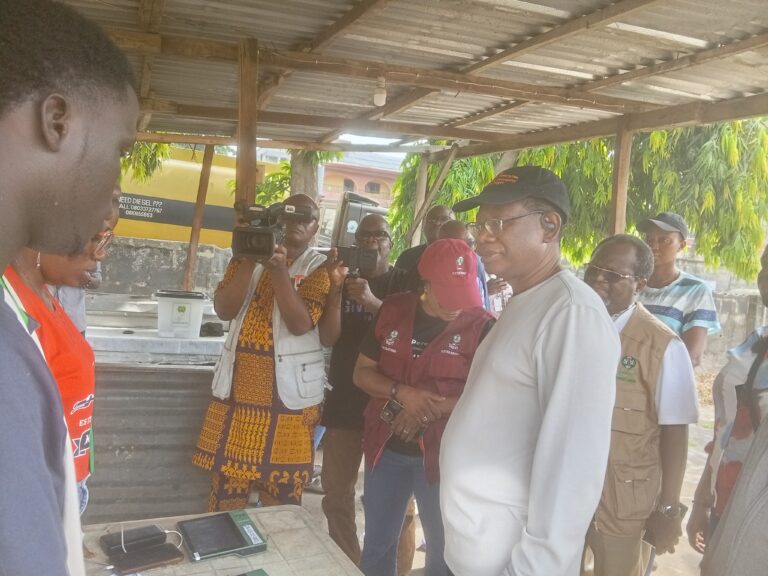
The Independent National Electoral Commission (INEC) in Lagos State has expressed satisfaction with the performance of its Bimodal Voter Accreditation System (BVAS) during Saturday’s nationwide mock accreditation and election simulation exercise.
The Resident Electoral Commissioner (REC) in Lagos State, Prof. Ayobami Salami, disclosed this while monitoring the exercise at selected polling units across the state.
Speaking with journalists at Polling Unit 057, Ward 07, Shitta/Ogunlana Drive, Surulere, Salami said the accreditation process had been seamless, with voters spending less than one minute to complete the exercise.
He said INEC officials had not recorded any complaints from electoral personnel, voters or members of the public since the exercise commenced.
“I have been very impressed with what we have seen. You have accompanied us on this exercise, and you have observed that there has been no problem with the BVAS.
“It takes less than one minute to accredit a voter, and everything has gone seamlessly. So far, there has been no complaint from our personnel, members of the public or voters,” he said.
The exercise, designed to test INEC’s technology, electoral materials, equipment and operational procedures ahead of the 2027 general elections, is taking place in 490 polling units across Lagos State.
Salami explained that two polling units were selected from each of the state’s 245 wards to assess the effectiveness of the electoral technology and processes.
On measures to reduce accreditation delays, the REC said INEC had reduced the number of registered voters assigned to a single BVAS machine from 1,250 to 850.
According to him, additional BVAS machines would be deployed to polling units with more than 850 registered voters to ensure a faster accreditation process.
He said the adjustment was intended to minimise waiting time and encourage greater voter participation during elections.
“If you have a polling unit with, say, 1,000 registered voters, what we previously had was one BVAS machine serving all the voters.
“To make accreditation easier and encourage more people to come out and vote, we have reduced the threshold from 1,250 to 850,” he explained.
On concerns about possible difficulties with biometric verification, Salami said voters must be successfully identified through either fingerprint or facial recognition before accreditation could be completed.
He stressed that INEC would not be able to accredit voters whose identities could not be verified through either of the two approved methods.
The REC also disclosed that no network failure had been reported since the commencement of the mock exercise.
“I have not seen anywhere where anybody has reported network failure. Since we started this morning, nobody has reported any network failure. As far as the network is concerned, the exercise has gone very well,” he said.
Addressing concerns about voter turnout, Salami said the exercise should not be compared with an actual election, noting that it was primarily designed to test the Commission’s preparedness and electoral systems.
He, however, described the turnout recorded so far as encouraging, despite the mock nature of the exercise.
About The Author
