


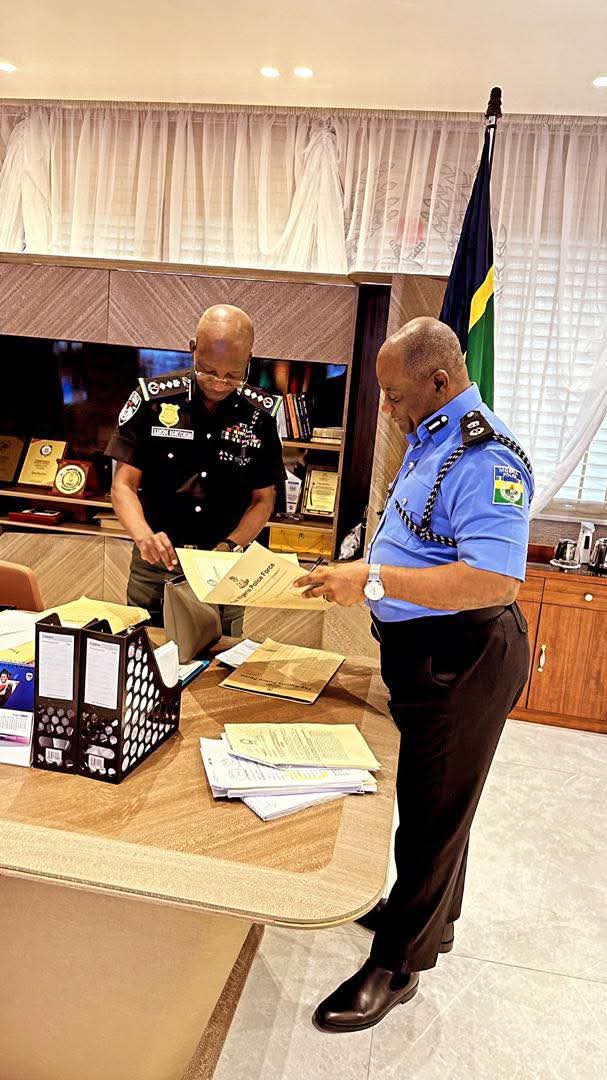
There are moments in public life that feel less like announcements and more like seasons changing. The news that AIG Tunji Disu, a 59-year-old Lagos Islander, would assume office as Acting Inspector-General of Police carried that quality. It was as though the first rain had fallen after a long, dust-heavy harmattan the air lighter, the leaves suddenly animated with hope.
Across Lagos, from the Government Secretariat in Alausa down towards Abule-Egba, Rivers to Ondo and to FCT one could sense an uncommon buoyancy among rank-and-file officers. Some spoke in tones ordinarily reserved for personal triumphs. “Now,” one officer remarked, scarcely disguising his relief, “I will enjoy my time as a police officer.” That sentiment simple, candid is not one to be dismissed lightly.
The departure of former Inspector-General Kayode Egbetokun marks the close of a tenure that was, by most accounts, eventful and at times contentious. Allegations of corruption, accusations of overstaying statutory retirement age, and broader concerns about public trust dogged his time in office. Yet, as the old saying reminds us, whatever has a beginning must surely have an end. Leadership, like the tide, recedes as inevitably as it rises.
But if Mr Egbetokun’s exit prompts reflection, Mr Disu’s ascent inspires expectation.
Mr Disu’s record, particularly during his tenure as Commandant of the Rapid Response Squad (RRS) in Lagos, has been frequently cited as evidence of a different temperament in policing one that blends operational firmness with public accessibility. In a country where the phrase “Police is your friend” has too often sounded ironic, he has sought to make it literal.
A retired officer who served alongside him in Rivers State described him as “an exceptional police officer and truly an example of a noble cop.” It is praise that rests not merely on sentiment, but on years of observed conduct.
The journalist Olugbenga Adewoye recounted a personal encounter that speaks to Mr Disu’s style of leadership. “Oga Tunji Disu is one of the most gentle, humble, and highly disciplined police officers I have ever met,” he wrote, recalling how the officer once deployed personnel to his home for a family ceremony and did so with warmth rather than hauteur. Such gestures may seem small in the grand theatre of national security, yet they reveal something elemental: how a leader sees people.
For in truth, leadership is tested not only in crisis rooms and command centres, but in everyday human encounters.
Nigeria’s police force stands at a delicate juncture. Welfare concerns, operational reform, internal discipline and the eradication of corruption remain urgent tasks. Public trust, once fractured, is not easily restored.
The President’s decision to elevate Mr Disu has been widely commended in political and civil circles alike. Traders, civil servants, journalists and politicians have greeted the appointment with notable enthusiasm. Such consensus is rare in our divided times and thus all the more significant.
Yet popularity at the outset is not the same as legacy at the end.
If there is a lesson woven through the transition from Mr Egbetokun to Mr Disu, it is this: power is transient, but character endures. The cheers that greet an appointment can just as swiftly accompany a departure or conspicuously fail to do so.
As the American author and leadership thinker John C. Maxwell once observed, “A leader is one who knows the way, goes the way, and shows the way.” But another maxim may be even more pertinent in public service: “People may forget what you said, but they will never forget how you made them feel.”
In positions of authority whether in uniform, in politics or in business it is dangerously easy to mistake fear for respect. Yet history repeatedly demonstrates that goodwill is the more durable currency.
The industrialist Andrew Carnegie put it succinctly: “No man will make a great leader who wants to do it all himself or to get all the credit for doing it.” And as former First Lady Michelle Obama has said, “Success isn’t about how much money you make; it’s about the difference you make in people’s lives.”
Perhaps the most sobering reminder for anyone elevated to high office is this African proverb: “The one who is carried on the shoulders of others must remember that he will one day walk on his own feet.”
The public reaction to Mr Egbetokun’s departure has been telling. On social media and in street-corner debates, more voices seemed inclined to celebrate the change than to eulogise the tenure. That reality should give pause to every office-holder.
For one day, every leader returns to civilian life to the same streets, the same public spaces, the same scrutiny of ordinary citizenship. Titles fade; reputations linger.
As Mr Disu begins his stewardship of the Nigeria Police Force, expectations are immense. Reform must be practical, welfare tangible, discipline impartial. But beyond policies and press statements lies something simpler, yet more demanding: the daily practice of humility.
“Be good to people on your way up,” goes a popular adage, “because you will meet them on your way down.”
In the end, intelligence may secure promotion, but it is humility that secures legacy. Nigeria watches, hopeful, watchful as a new chapter begins.
– Debo Omilani writes from Alausa, Ikeja
Share this content:
About The Author
