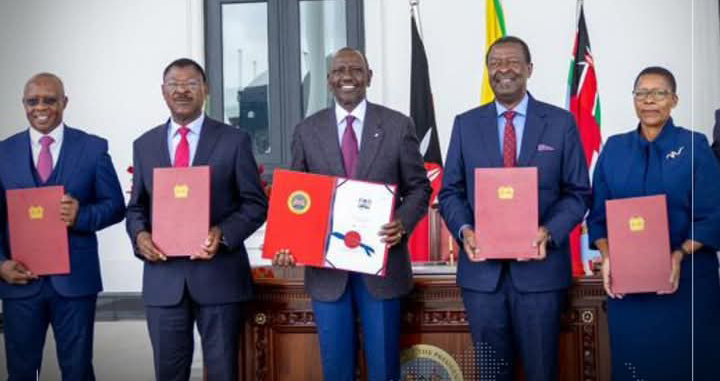
President William Ruto has signed into law the Value Added Tax (Amendment) Bill, 2026, reducing VAT on petroleum products from 16 percent to 8 percent in a bid to cushion consumers from rising fuel costs.
The signing took place at State House Nairobi, following mounting public concern over a recent spike in fuel prices.
The Bill, sponsored by National Assembly Majority Leader Kimani Ichung’wah, was fast-tracked by Parliament after the Executive called for urgent intervention. Lawmakers introduced, debated, and passed the legislation on April 16, 2026, without amendments, underscoring the urgency of the situation.
The tax reduction goes beyond the limits set under the VAT Act, which restricts the powers of Treasury Cabinet Secretary John Mbadi to a maximum 25 percent adjustment.
Under the new law, the reduced VAT rate will remain in force for an initial 90 days. The Treasury is also empowered to extend the relief for an additional 90 days if necessary.
The measure has been backdated to take effect from April 15, 2026, aligning with the President’s directive to Parliament.
According to the Energy and Petroleum Regulatory Authority, the tax cut will lower the price of super petrol by Ksh.9.37 per litre and diesel by Ksh.10.21 per litre. As a result, the new maximum retail prices stand at Ksh.197.60 per litre for super petrol and Ksh.196.63 per litre for diesel, while kerosene remains unchanged at Ksh.152.78 per litre.
Government officials say the move is aimed at easing pressure on households and businesses, noting that fuel prices significantly affect transport costs, food prices, and the overall cost of living.
However, the decision has attracted criticism from some quarters, with opponents arguing that the government’s pattern of raising fuel prices sharply before introducing partial reductions gives the impression of reacting to public backlash rather than preventing economic strain.
Stay informed! Follow our WhatsApp Channel for the latest updates:
https://whatsapp.com/channel/0029VbBu3PYH5JLpDP9NJh0A
About The Author