


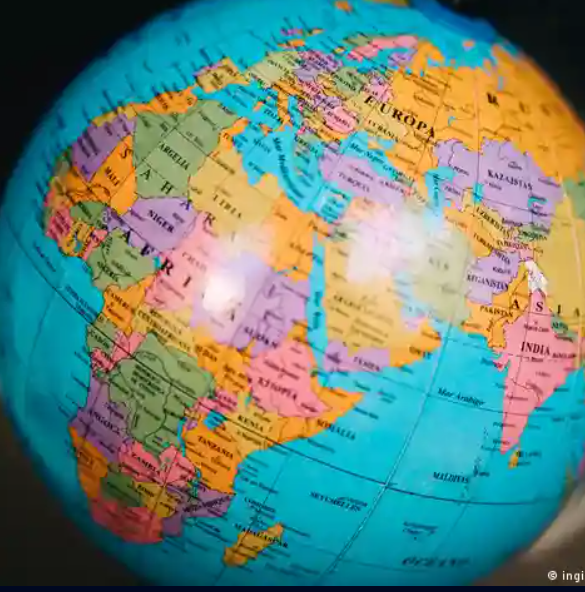
The United Nations General Assembly has backed a major shift in how the world is visually represented, with 164 countries voting in favour of the Equal Earth map, while the United States voted against and six countries abstained.
The vote followed a yearslong campaign, led in part by African countries, to promote the Equal Earth cartographic projection as a more accurate way of depicting the relative sizes of the world’s continents.
According to the resolution, the Equal Earth projection “offers a more accurate representation of the sizes of continental landmasses” and could improve the accuracy of world maps.
Togo’s Foreign Minister, Robert Dussey, told the UN that maps play a significant role in shaping how people perceive the world.
“Maps shape our understanding of the world,” Dussey said, arguing that distorted representations can influence education, imagination and collective perceptions for generations.
The resolution calls on countries to consider adopting the Equal Earth projection instead of the traditional Mercator projection, developed in 1569 by Flemish cartographer Gerardus Mercator.
Although the Mercator map accurately represents the shapes and angles of landmasses, making it particularly useful for maritime navigation, it significantly distorts their relative sizes.
Countries and territories close to the Earth’s poles appear much larger than they actually are, while regions around the equator appear comparatively smaller.
One of the most striking examples is Greenland, which can appear almost as large as Africa on a Mercator map, despite Africa being roughly 14 times larger.
Dussey said Togo plans to replace maps based on the Mercator projection in its schools by the end of the year.
He also linked the continued use of the Mercator projection to the legacy of colonisation, declaring: “The world is changing. Africa also is changing.”
France Backs the Change
France, which co-sponsored the resolution, also announced that it would move away from the Mercator projection.
French Foreign Minister Jean-Noel Barrot said the traditional map gives disproportionate visual prominence to countries such as the United States, Russia and China compared with Africa, Latin America and Southeast Asia.
“Changing maps obviously doesn’t change the world,” Barrot said. “But correcting a distorted representation is already an act of truth.”
Supporters of the campaign have further highlighted Africa’s enormous landmass, arguing that the United States, China, India, Japan, Mexico and much of Europe could fit within Africa, with additional land still left over.
Despite the overwhelming vote, the UN General Assembly resolution is not legally binding.
Share this content:
About The Author

Honestly the best slot experience I have had in a while. The graphics are great and the payouts feel fair. I am hooked! mega303slot