


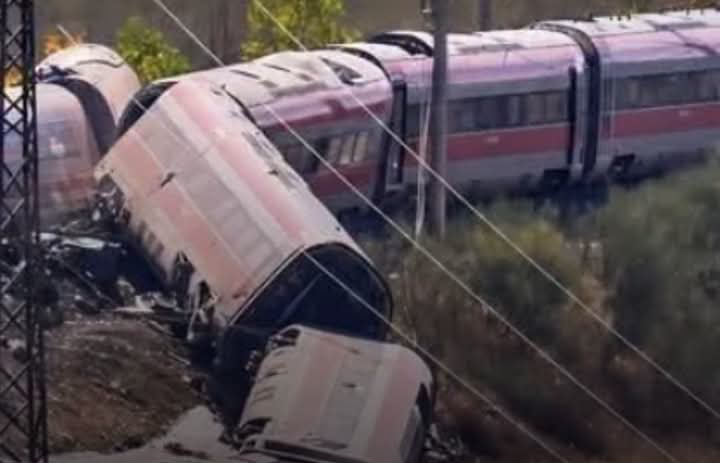
At least 64 people have reportedly died following a collision between two high-speed trains in Spain’s Toledo province, although earlier official updates put the death toll at 30 as emergency operations continued.
A collision involving two high-speed trains on Spain’s Madrid–Seville railway line has left dozens of people dead and many others injured, raising fresh concerns about railway safety in the European country.
The accident occurred at about 8:54 a.m. on Wednesday, October 28, 2026, near Urda, between the towns of Mora and Orgaz in Toledo province, according to reports by El País, Euronews and Spain’s state railway operator, Renfe.
The trains involved were a Renfe AVE service and an Iryo high-speed train, both operating on the Madrid–Seville route.
Initial reports indicated that the Renfe train struck the rear of the Iryo service, which was reportedly stationary on the tracks. The impact caused several carriages to derail, with some plunging down an embankment.
According to El País, the two trains were carrying approximately 544 passengers, including an infant. The Renfe service had 397 passengers, while the Iryo train was carrying 147 people, including the baby.
Firefighters, Civil Guard officers, medical personnel and civil protection teams were deployed to the crash site to rescue passengers, treat the injured and recover victims.
Medical teams established emergency treatment facilities near the scene, while injured passengers were transported to hospitals in the surrounding region.
Authorities warned that the number of casualties could increase as rescue operations and assessments continued.
Renfe confirmed that it had activated its crisis management procedures and a support plan for victims and their families.
The company also announced that railway services between Madrid, Ciudad Real and Andalusia had been suspended following the collision.
Spain’s railway infrastructure manager, Adif, confirmed that the incident had disrupted high-speed services along the Madrid–Andalusia corridor.
Although the precise cause of the collision remained under investigation, preliminary reports pointed to a possible signalling-system failure and a potential human error involving railway traffic control.
El País reported that initial findings suggested the Renfe train may have been authorised to continue despite the Iryo train remaining stationary on the tracks.
However, authorities had not established a definitive cause, and the circumstances surrounding the collision were still being examined.
The investigation is expected to determine whether technical problems, operational decisions or other safety failures contributed to the disaster.
The collision came months after the January 2026 train disaster in Adamuz, Córdoba province, which killed 46 people.
The latest accident has renewed questions about railway safety and emergency response on one of Spain’s major high-speed rail corridors.
As rescue efforts and investigations continue, authorities are expected to provide further updates on the confirmed death toll, the number of injured passengers and the circumstances leading to the collision.
Share this content:
About The Author
