


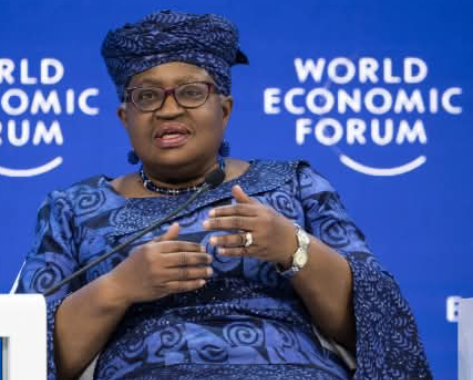
The Director-General of the World Trade Organisation (WTO), Dr Ngozi Okonjo-Iweala, has called on Nigeria to actively court global investors and position itself as a destination for companies relocating supply chains amid rising geopolitical tensions.
She was speaking on Wednesday at Nigeria House during the World Economic Forum (WEF) in Davos, Switzerland.
Dr Okonjo-Iweala said growing trade frictions, particularly between the United States and China, have accelerated efforts by multinational companies to diversify production and sourcing, creating opportunities for countries able to attract new investment.
Addressing a panel discussion titled From Scale to Capital: Financing Nigeria’s Role as Africa’s Digital Trade and Infrastructure Anchor, she noted that many firms are adopting “China plus one” strategies to reduce reliance on a single manufacturing base.
“These disruptions in global supply chains present opportunities, but countries have to be deliberate in capturing them,” she said.
The WTO chief said Nigeria must move beyond economic stabilisation and focus on policies that translate reforms into job creation through manufacturing and investment.
“Some good reforms are being pursued right now, but they must lead to jobs,” she said, adding that Nigeria needed to clearly identify sectors where it could compete and attract foreign direct investment.
Dr Okonjo-Iweala urged the government to take a more proactive approach to investment promotion, including directly engaging potential investors in key global markets.
“Everything we can do to showcase Nigeria as a country worthy of investment is what we should be doing,” she said.
She noted that while much of the current supply chain diversification is taking place within Asia, benefiting countries such as India, Nigeria should work to secure a share of those shifting investments.
Highlighting specific opportunities, Dr Okonjo-Iweala said Nigeria has the capacity to manufacture solar panels locally, rather than relying heavily on imports, given its renewable energy potential.
She also pointed to the fashion and textile industry, saying Nigeria continues to import many of the fabrics widely used by its population.
“We should be attracting investment to produce these at home instead of importing them,” she said.
The pharmaceutical sector was identified as another area with strong growth potential, where Nigeria could become part of global supply chains if the right policies and incentives are put in place.
Also on the panel was the Managing Director of the Bank of Industry, Dr Oludapo Olusi, as discussions focused on financing, infrastructure and Nigeria’s role in Africa’s digital and trade landscape.
Share this content:
About The Author
