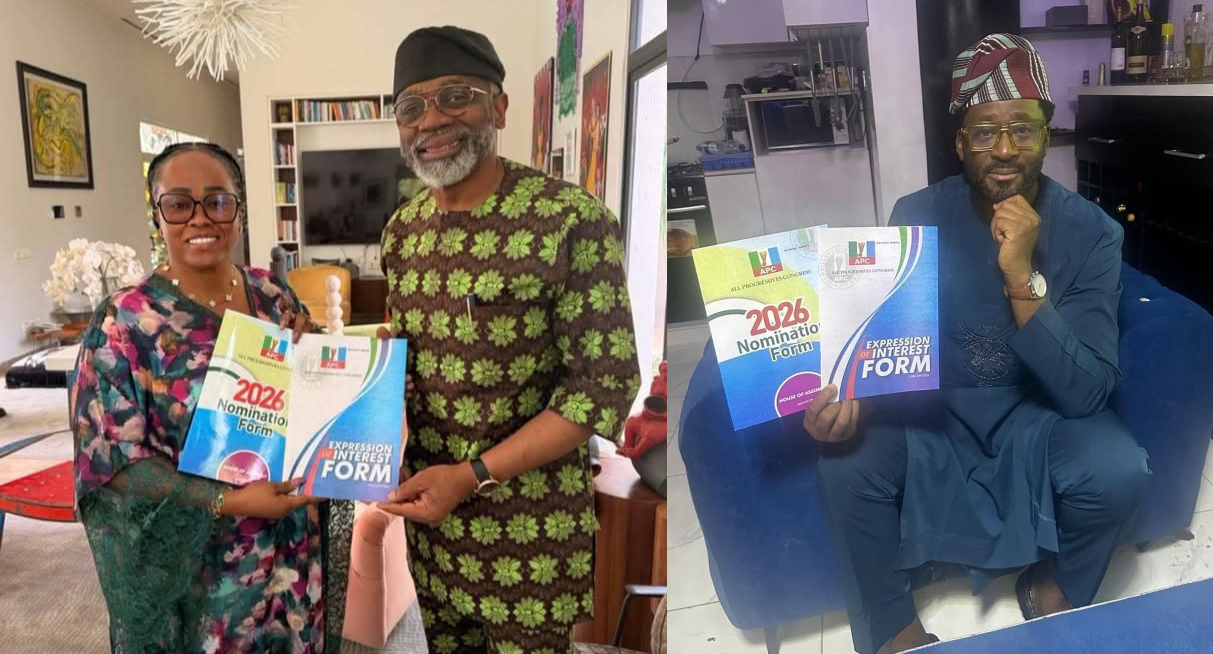
There is a photograph circulating on social media that speaks volumes without uttering a single word. In it, a man sits alone on a blue sofa, dressed in a smart teal agbada and a traditional cap, his hand thoughtfully cupped beneath his chin, holding up two APC documents a 2026 Nomination Form and an Expression of Interest Form for the Lagos State House of Assembly. He is composed. He is camera-ready. He is, unmistakably, Hon. Desmond Elliot presently represents Surulere Constituency 1. And he is completely, strikingly, alone.
No crowd of jubilant supporters pressing in from every angle. No women tying gele and ululating in the background. No ward chairmen in matching ankara, no youth corps of loyal foot soldiers hoisting banners. Just a man, his forms, and the quiet hum of what appears to be a kitchen appliance behind him. For a politician seeking a fourth return to the Lagos State House of Assembly to represent Surulere Constituency I, the image is as telling as it is troubling.
In Yoruba political culture, the purchase of a nomination form is not a solitary, private act it is an occasion. It is a ceremony. When a principal picks up his forms, the crowd around him sends a signal to the world, and especially to party delegates: this is a man with a movement behind him, not merely a name on a form. Drummers drum. Women dance. Aso-ebi flows. The crowd becomes the message. Desmond Elliot’s photograph offers none of that energy. What it offers is a carefully staged solo portrait, the forms held up like a corporate product launch. It looks less like a political declaration and more like a one-man press conference.
One cannot help but ask: where are the people? The silence is the story. The absence in that photograph is not accidental. It is a political fact. It is a visual testimony to a question that has been silently gathering weight across Surulere for months: does Desmond Elliot still have a mandate? Or more precisely does he have the mandate from the people who matter most in determining his political future?
To be fair to Elliot, his journey from Nollywood heartthrob to elected legislator is not without genuine footnotes of service. First elected in 2015 and subsequently re-elected across multiple terms, he rode into Ikeja on waves of celebrity goodwill and the machinery of the All Progressives Congress. He leveraged his public profile, facilitated projects across Surulere, and consistently identified with the APC structure in Lagos. His supporters point to road rehabilitation interventions, visibility during community engagements, and a party loyalty that Lagos APC has, on occasion, rewarded. He has shown up. And in Nigerian politics, showing up is not nothing.
But showing up and delivering are two entirely separate constituencies. And the murmurs from Surulere have grown into something closer to a roar.
Residents of Surulere Constituents, traders at Tejuosho Market, professionals along the Adeniran Ogunsanya corridor, students and young people who once cheered his candidacy have grown increasingly vocal about their disillusionment. The complaint is familiar in Nigerian legislative politics: the yawning gap between the glamour of the representative and the grimness of the represented. Critics point to persistent infrastructure decay, unresolved flooding that swallows streets whole, and what many describe as a representative more visible on Instagram than in the legislative trenches during budget defence sessions.
Then there is his 2021 House comment suggesting social media users bore responsibility for insecurity remarks that ignited firestorms of backlash particularly among the young, digitally-connected population that had once celebrated his election. That episode revealed a fundamental disconnect: the world the celebrity-lawmaker inhabited and the world his constituents navigated daily were not the same.
In his official Facebook statement announcing the form purchase, Elliot wrote: “I wish to formally inform all Surularians, workers, residents, political associates, leaders, stakeholders, and the good people of Surulere, that I have obtained the nomination form to seek a return mandate to the Lagos State House of Assembly, representing Surulere Constituency 1.”
He went further, making what may be his most compelling legislative argument: “My going back makes me automatically a ranking member and loads of benefits come to our constituency as a result of this feat. By the grace of God Almighty I become one of the oldest members in the house and in a structure where older members are given priority concentration, we can be rest assured Surulere will benefit immensely.”
It is a reasonable argument seniority in a legislature does carry structural advantages. But it is also the argument of a man who knows his achievements alone may not be sufficient. When a returning legislator’s strongest selling point is institutional rank rather than transformational impact, it tells its own story.
But the true measure of Elliot’s isolation became starkly visible not in what he said about his constituency, but in what he said about his political standing.
In one of the most extraordinary moments to emerge from this electoral cycle, Elliot publicly appealed to President Tinubu’s Chief of Staff, Femi Gbajabiamila, for forgiveness while simultaneously insisting he may not have actually offended him. The contradiction itself is revealing. His words, delivered to journalists after picking up his forms, were remarkable in their vulnerability and their desperation: “Our leader is a compassionate leader. A leader of thought. We are children. Children sometimes err. If I have erred in any way, my leader, I am sorry. Give me another chance, and let’s move on, and let’s bring more dividends of democracy to the people.”
This is a sitting lawmaker, an incumbent with three terms behind him, publicly prostrating before the Chief of Staff of the Federal Republic not for a confirmed offence, but for a vague, unspecified falling-out whose details he himself declined to clarify. It is an act of political desperation dressed in the language of humility. And it reveals the deepest source of Elliot’s isolation: he stands outside the circle of power.
Gbajabiamila, as Chief of Staff to President Bola Tinubu, wields influence within Lagos APC politics that transcends normal titles and portfolios. He is the fulcrum around which Lagos party decisions rotate, the custodian of presidential interests in the state, and the man whose nod opens and closes doors that no amount of grassroots mobilisation can override. When Gbajabiamila backs a candidate, the weight flows down from the highest office in the land through every layer of the party structure. The fact that Elliot felt compelled to make a public apology to him before cameras, before the press is not courtesy. It is acknowledgement of a brutal political truth: the Chief of Staff holds the key to the door he is trying to enter, and he fears that the key has been turned against him.
Standing opposite Elliot in this contest is Mrs. Barakat Adenuga Bakare, a figure whose credentials represent everything Elliot’s solo sofa visibly lacks institutional backing, structural depth, and the most consequential endorsement available in Lagos politics. Mrs. Bakare is the former Special Adviser on Housing to Lagos State Governor Babajide Sanwo-Olu. She is embedded within the executive machinery of Lagos governance, a product of the system, tested within it, and critically trusted by it. But her decisive advantage is this: she is widely reported to be Femi Gbajabiamila’s anointed candidate for Surulere Constituency I. Where Elliot stands alone, publicly seeking forgiveness, Bakare reportedly walks through the doors of power with ease.
The question circulating in political circles is blunt: is Desmond Elliot’s return for a fourth term completely and irreversibly ruled out? The honest answer is: not with absolute certainty but the structural odds stacked against him are difficult to overstate.
Nigerian politics operates on the logic of structural power. Grassroots popularity matters; community goodwill matters; celebrity recognition matters at the margins. But when the party machine moves in a unified direction especially when that direction is set from the apex of executive power the odds of an individual candidate swimming against that current are historically poor. Elliot’s only realistic path to victory runs directly through Gbajabiamila’s forgiveness and restored party favour. His public apology suggests he understands this. But forgiveness in politics is rarely unconditional, and the hands that could grant it appear to have already placed themselves firmly on Mrs. Bakare’s shoulders.
What Elliot has going for him is the unpredictability of Nigerian internal party processes primaries can shift, delegate arithmetic can move, and the Lagos machine is not entirely immune to the unexpected. But hope is not a strategy. A solo photograph, a public apology tour, and a seniority argument do not, together, constitute the foundation of a campaign that can overcome a well-connected, executive-backed challenger with direct access to the most powerful political figures in the country.
The photograph tells the story that official statements cannot erase. It is a portrait of isolation not by choice, but by circumstance. A man seeking a fourth term, holding up his forms with camera-ready composure, but surrounded by silence instead of celebration. No crowd. No momentum. No visible movement behind him. Desmond Elliot’s supporters urge him to remain “calm, steadfast, and focused.” It is good counsel. But calmness does not fill empty sofas. Steadfastness does not explain absent crowds. And focus, however admirable, cannot manufacture the political momentum that the picture of his form purchase so visibly failed to capture.
Mrs. Barakat Adenuga Bakare enters this race with structural advantage, executive pedigree, and the most consequential political endorsement available in Lagos. She enters not as a disruptor but as an establishment candidate which in the context of Lagos APC is as powerful a starting position as any aspirant could hope for. The forms have been purchased. The declarations have been made. The apologies have been delivered. But Surulere is watching and from the texture of the political ground today, the isolation in that photograph appears less like a moment in time and more like a preview of political destiny.
The constituency will deliver its verdict. But the signs, for now, point in one undeniable direction: a man alone cannot move a machine set in motion by power far greater than his own.
About The Author