


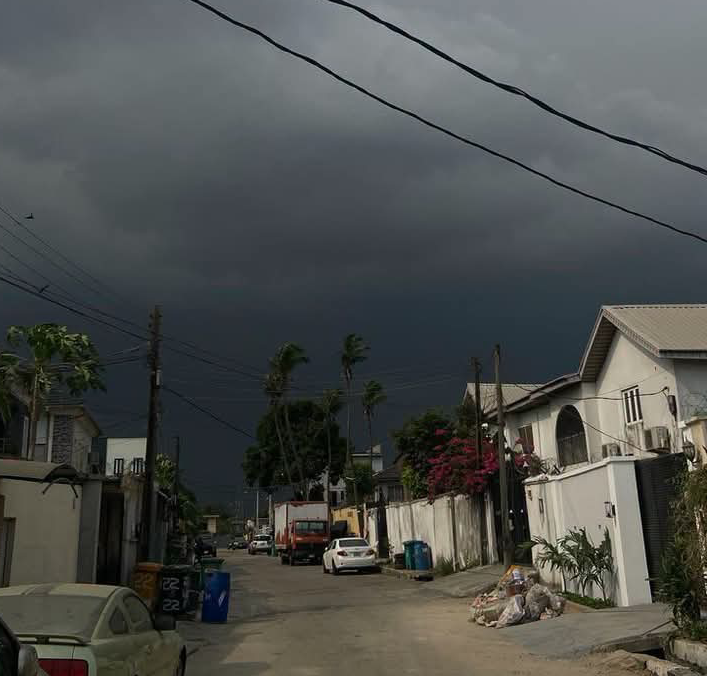
Look at the photograph carefully. Not as a casual observer scrolling past another image of a Nigerian road in the rainy season. Look at it with the eyes of a man who has studied storms.
That sky is not merely overcast. It carries the particular weight of a sky that has already made up its mind. The clouds are not passing through they are arriving. Dense, deliberate, and unhurried, they have rolled across the horizon with the quiet confidence of something that does not need your permission. Any Yoruba farmer who has worked the land long enough will tell you: a sky like that is not a threat. It is a promise.
It is, if I may say so bluntly, the most honest metaphor I know for what is coming toward the Southwest.
For years, the conversation about banditry, kidnapping, and the violent dispossession of Nigerian communities has been narrated to us as a Northern story. We received it with appropriate sympathy from the comfortable distance of Lagos drawing rooms and Ibadan faculty common rooms. We debated it on radio. We discussed it in the marketplaces and in commercial buses. We prayed about it in church. We raised our hands at the mosque. And then we went home, locked our gates, and thanked God that geography had, so far, been merciful to us.
That mercy is wearing thin.
The reports are no longer isolated curiosities. Kidnappings along Ondo highways. Suspicious movements inside forests straddling Ogun and Oyo boundaries. Farmers in Orire Local Government unable to go to their fields without counting the cost in fear. Schoolchildren snatched in Ogbomoso. The bandits have not sent a formal announcement they never do but their advance scouts are already here, learning our roads, reading our forests, and measuring the width of our response.
Let no one tell you these are unconnected events. The dark clouds in that photograph are not unconnected droplets of water vapour. They are a system. And security systems, like weather systems, do not respect sentiment.
I have grown weary of a particular kind of speech that emerges whenever insecurity creeps toward comfortable constituencies. It is the speech of delay. It speaks in the language of “monitoring the situation.” It promises “sustained operations.” It convenes committees. It issues statements. And while the speech is being delivered, the clouds continue to gather.
What the Southwest requires now is not another statement. It is a reckoning.
Where are the traditional rulers in this hour? The Ooni of Ife carries the spiritual weight of a civilization. The Olubadan of Ibadan commands the respect of millions. The Oba of Lagos rules over Africa’s most commercially vibrant city. These are not ceremonial titles. In the architecture of Yoruba society, traditional rulers are the sinew that holds community together.
Security experts including former Director-General of the Department of State Services, Mike Ejiofor have said it repeatedly: community-based intelligence is the most effective early warning system against emerging threats. Our monarchs sit at the centre of precisely that intelligence network. Yet their voices on this gathering storm remain, for the most part, conspicuously quiet.
I say this with respect, because the alternative saying nothing would be its own kind of betrayal.
The governors, too, must answer some uncomfortable questions.
Six states. Six security votes. Six state security councils. Amotekun that bold, controversial, necessary experiment in regional self-defence was launched precisely because the Southwest recognised that waiting for Abuja was a luxury it could no longer afford. Yet what Amotekun has become in practice too often resembles what it was designed to replace: underfunded, under-equipped, and politically managed rather than operationally empowered.
The recent revelations about Orire Local Government are instructive and infuriating. Communities that should represent the capillaries of a functioning state where children go to school, where farmers go to their land, where women go to the market are functionally abandoned in terms of security infrastructure. Meanwhile, public funds flow through budgets that communities cannot audit, in amounts that communities cannot verify.
President Tinubu’s push for genuine local government financial autonomy was meant to correct this. Yet several states have dragged their feet on implementation, preferring the old arrangement in which governors control what reaches the grassroots. In security terms, that reluctance has a cost. Communities that cannot govern themselves cannot protect themselves.
Bags of rice at election time will not stop a kidnapper’s rope.
I want to be precise about what I am not arguing. I am not arguing for panic. Panic produces exactly the kind of social fracture that armed non-state actors depend on. Security analyst Kabiru Adamu has spent years pointing out that ethnic profiling and collective suspicion of entire communities have historically been more useful to bandits than to their victims.
The Southwest’s tradition of hospitality and coexistence is not a weakness; it is a strategic asset, and it must be preserved.
What I am arguing for is the opposite of panic: deliberate, coordinated, unsentimental action.
The six Southwest governors should convene an emergency security summit not in Abuja, not through press releases, but in a room together with traditional rulers, Amotekun commanders, faith leaders, market association heads, transport union leaders, and representatives of rural farming communities who are already living inside the threat that the rest of us are still only discussing.
Religious leaders carry an obligation that this moment demands they fulfil. The pulpit and the minbar remain the most penetrating communication platforms in Nigerian society. Security awareness, community vigilance, and the duty of citizens to share intelligence with lawful authorities are entirely consistent with the moral teachings of both faiths.
Silence from faith leadership in the face of a gathering storm is not neutrality it is absence.
I return, finally, to the photograph.
The road in that image stretches forward into the heavy sky with a peculiar kind of defiance. The driver whoever they are has not turned back. They are moving toward the cloud, not away from it. There is something in that posture that feels distinctly Yoruba to me: the willingness to press into difficulty with eyes open.
But eyes open means eyes open. It means seeing what is there, not what we wish were there.
The sky over Yorubaland is not yet a catastrophe. The storm has not broken. But anyone who has watched a sky like that long enough knows that the interval between gathering and breaking is shorter than it looks, and that the time to find shelter is not when the first rain falls, but precisely now, while the road is still dry enough to run.
The question before the Southwest before its governors, its monarchs, its clerics, and its citizens is simply this: what are we doing with the warning we have been given?
History will not be patient with another committee. Neither will the clouds.
— Debo Omilani, Communications Expert and Public Affairs Commentator
:::
Share this content:
About The Author
